
I spend hours every summer making pickles, jams and other canned goodies to put away for the rest of the year.
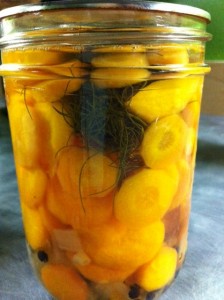
Dilled carrots for sandwiches, salads or a cheese plate some time this winter.
I love being able to walk to my shelf and pull out raspberry jam or dill pickles when it’s minus 20 outside and know that it came from our local farmers and was put away when it was fresh. I love showing up at Thanksgiving with spicy green beans for bloody marys or to dinner party with a jar of cherry walnut relish. And I love how the jars add color to my kitchen throughout the year.
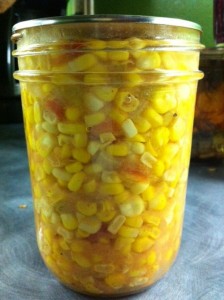
This summer’s first batch of corn relish.
So I am constantly being asked by people to teach them how to can.
I really learned to can by teaching myself. I took a class from the University of Wyoming extension office for reassurance that what I had taught myself was, in fact, correct. They are a great resource, and they will take time to answer any question you have. Call Jennifer Jacobson, nutrition and food safety, at 733-3087.
But my best advice is to find a book you like and follow the recipe (any canner will tell you that if you stray from a tested recipe, you run the risk of poisoning yourself with botulism. That’s nasty. So just follow instructions to a T). There’s nothing to be scared of. It can be time consuming but is totally worth it in the middle of winter. Feel free to email me with questions.
Here’s a handy little primer for teaching yourself how to can (this is the water-bath method only):
-Find a book that you love. Because I can’t teach you everything you need to know in one blog post, buy a book. I am currently using Put ‘Em Up! by Sherri Brooks Vinton (she graciously allowed me to post the recipe at the end of this post). This is a great resource because she includes diagrams for each step of the process. Before buying the book, I flipped through all the recipes to make sure I would like them. In addition to canning, she also offers tips on how to dry and freeze produce. These books also look intriguing: Canning for a New Generation: Bold, Fresh Flavors for the Modern Pantry; Tart and Sweet: 101 Canning and Pickling Recipes for the Modern Kitchen and The Joy of Pickling: 250 Flavor-Packed Recipes for Vegetables and More from Garden or Market.
-Buy the proper equipment. The Whole Grocer, Smith’s and Albertson’s all have everything you need to begin canning. Look for a kit like this and jars like these.
-Read the recipe before you begin: I used to start the canning process before I read the recipe. And then I would always run into issues, like the wrong jars or too little produce. Now, a few days before I actually begin canning, I know what I am going to make. That way I can ensure I have the proper size of jars and enough produce. I also write myself a shopping list so that when I go to the farmers market, I know how much of each item to buy. It also helps to know what is in season so you know what you can actually make. Check here for weekly updates on what is available at our area market. (This weekend, I know the market will have pickling cucumbers, corn, tomatoes and peppers, so there’s a ton of options!)
-Follow instructions. Do not deviate from the recipe. I repeat: Do not deviate from the recipe. This will ensure your food does not spoil while in storage.
-Remember to adjust for altitude. If a recipe calls for 20 minutes or less of processing, increase processing time by 1 minute for each 1,000 feat above sea level. The University of Wyoming recommends 6 minutes for here in Jackson. If a recipe calls for greater than 20 minutes of processing, increase processing time by 2 minutes for each 1,000 feet above seas level (12 minutes here in Jackson).
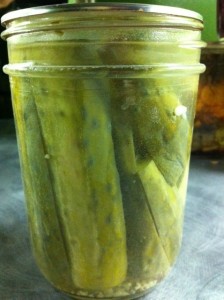
My first batch of dill spears, an easy first canning project.
Here’s a few handy websites:
USDA Complete Guide to Home Canning
National Center for Home Food Preservation
Jarden Home Brands

Ingredients
- 5 pounds pickling cucumbers, ends removed and cut into pint-jar-size spears
- 1/2 cup salt (make sure it's pickling salt, not kosher or table salt)
- 2 cups ice cubes
- 4 cups distilled white vinegar (this must be 5 percent acidity)
- 2 cups water
- 2 Tbsp. sugar
- 8 garlic cloves
- 2 Tbsp. dill seed
- 1 tsp. celery seed
- 1 tsp. peppercorns
Instructions
- Layer the cucumbers with the salt in a large bowl and cover with a layer of ice cubes. Set aside for two hours. Drain, rinse and pack into clean, hot pint canning jars.
- Combine the vinegar, water, sugar, garlic, dill seed, celery seed and peppercorns in a medium nonreactive saucepan, and bring to a boil. Pour the hot brine over the spears to cover by 1/2 inch. Leave 1/2 inche of headspace between the top of the liquid and the lid.
-When you first start canning, it helps to print off these step by step instructions so you can make sure you aren’t forgetting anything. Place the sheet on your counter for reference. (From University of Wyoming extension office).
Canning Procedures, A Basic Outline
Ingredients
- Ball or Kerr jars (make sure they are the correct size for the recipe. You can always can in smaller jars but never go bigger than the recipe calls for)
- Kitchen scale (I find this valuable to ensure I am using the correct proportions
- Canning or pickling salt (it has different properties from other salts, so only use this)
- 5 percent acidity vinegar (you may be tempted by exotic vinegars, but use this unless otherwise specified)
- Pectin (You can find pectin at any grocery store. If it calls for Pomona's, Whole Grocer is the only one I've found that carries it)
Instructions
- Review tested recipe instructions, plan time, assemble equipment.
- Fill canner halfway with hot water, cover and preheat (140 F for raw-pack, 180 F for hot-pack).
- Prepare ingredients.
- Place lids in small saucepan and simmer over medium heat until ready to use — Do not boil.
- Fill jars one at a time with prepared food making sure to leave proper headspace.
- Remover air bubbles and add food back to proper headspace if necessary.
- Wipe jar rime using clean cloth to remove any residue.
- Place lid on jar, apply band and adjust to fingertip tight.
- Place jars in rack and lower into canner. Leave 1 to 2 inches of water covering jars.
- Place lid on canner and bring to a boil.
- Set time once water boils and process for required time.
- Turn off heat once processing is complete. Remove lid and wait 5 minutes before removing jars.
- Leave jars undisturbed on the counter for 12 to 24 hours.
- Check for a good seal.
- Remove screw bands, label and store in a cool, dry, dark place.
- Consume within the year.